
The library of validated battery-process models, made usable.
Aikemics Studio packages 13+ years of computational models from Prof. Franco's research group into a workspace any process or materials engineer can use. Progressive product families cover every step from slurry to formation. Every output carries an explicit confidence score.
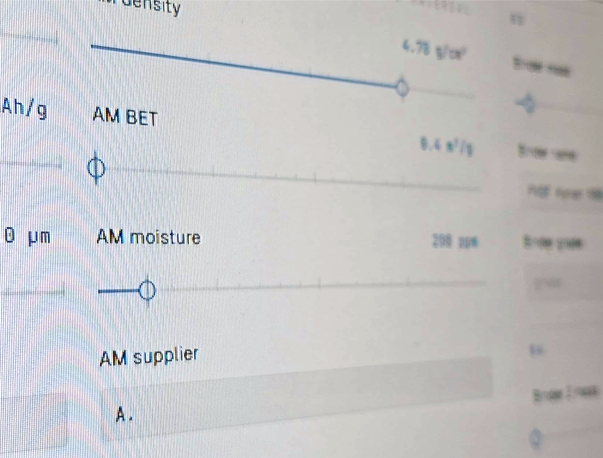
One workspace, built around engineering decisions.
Studio is the single interface to the Aikemics platform. Mesoscopic simulators, AI surrogates and process modules all appear in the same library view. You browse by process step, chemistry or capability, configure with sensible defaults, run, and read the results next to the inputs that produced them.
The same workspace covers research-grade configuration for R&D leads, parameter sweeps for process engineers and operator-level dashboards for control rooms. One model serves all three audiences through different views. Nothing round-trips through exported spreadsheets, so the link between an input and its outcome stays intact.
Progressive product families, shipped on a public roadmap.
CO-SIMU
Available today
Validated mesoscopic simulators (CGMD, DEM, LBM, FEM) for every electrode process step from slurry through infiltration. Direct 3D-to-3D simulation, qualified on your samples before delivery.
ML-PREDICT & ML-REVERSE
Q4 2026
Physics-informed ML surrogates of the CO-SIMU library. Forward: process parameters → outcomes. Inverse: target outcomes → recommended settings. Trained on synthetic data, calibrated on your measurements.
ML-INSIGHT
Q2 2027
Recovers hidden process variables from partial sensor data. Infers latent quantities (internal coating uniformity, true binder migration) that drive yield but cannot be measured directly.
ML-FEEDBACK
Q1 2028
Supervised autonomous adjustment of process parameters in closed loop. Combines the Studio model library with live sensor data to co-pilot the line under human supervision.
Studio flags when a prediction is outside its confidence range.
Every Studio module ships with explicit validity guards. Inputs outside the trained perimeter are flagged before a run starts. Outputs carry a confidence score derived from the underlying physics and the training distribution.
Built-in scientific assistance helps configuration, execution and interpretation. It explains what each parameter does, suggests sensible defaults for the chemistry in scope, and points to the peer-reviewed publication behind each model. A process engineer can run the platform without a PhD in computational electrochemistry or material processing.
Questions that come up in every Studio evaluation.
One workspace, every process step, every audience.
Which process step matters most for your line? We arrange a Studio walkthrough on a matching CO-SIMU module and outline the ML upgrades on the roadmap.