
Multi-physics film formation and solvent transport.
Coupled CGMD, DEM, CFD-DEM and Physics-Assisted Machine Learning model the full film-formation step from wet slurry to dry, structured electrode, with capillary-driven binder migration and gas–liquid interfaces explicitly resolved.
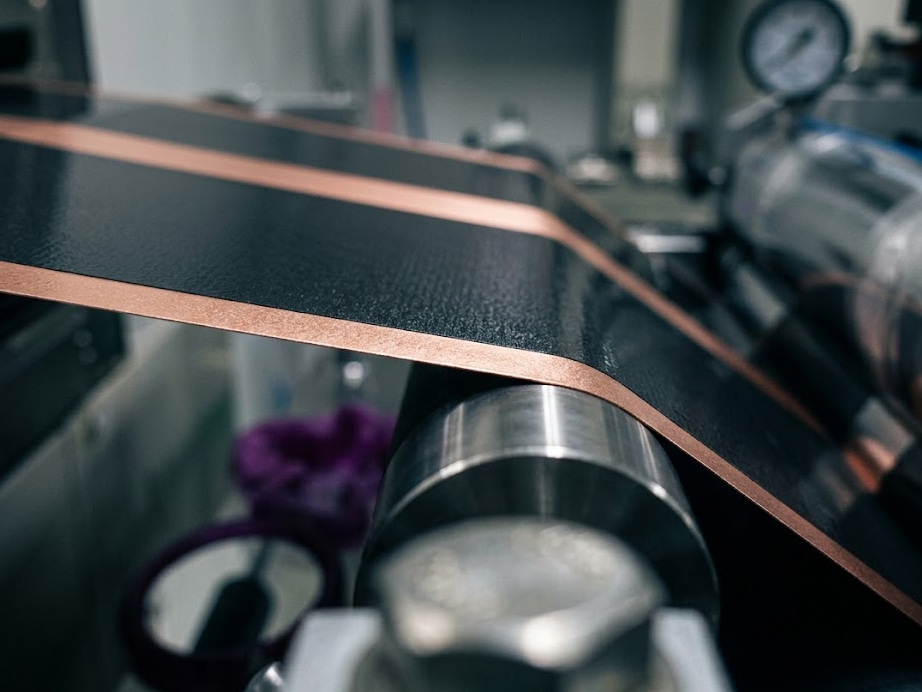
By the end of drying, most of your microstructure is already set.
Drying simulation relies on two complementary particle-resolved approaches. CGMD propagates the slurry microstructure through solvent evaporation by progressively removing solvent beads, conserving the chemistry of binder–particle interactions. DEM captures the mechanical consolidation front, capillary-driven CBD (carbon–binder domain) migration, and binder redistribution along the electrode thickness, using surrogate fluid-force models for buoyancy, Stokes drag and lubrication.
CFD-DEM coupling provides the most physically complete picture by resolving fluid–particle interactions and evaporation kinetics simultaneously, at the cost of significantly higher computation times, so we reserve it for the cases where that resolution matters.
Choose the resolution your decision needs.
CGMD evaporation
Propagates slurry microstructure through solvent evaporation by progressively removing solvent beads, preserving particle–binder chemistry from the slurry step.
DEM consolidation
Resolves the mechanical consolidation front, capillary-driven CBD migration and binder redistribution using surrogate fluid-force models for buoyancy, Stokes drag and lubrication.
CFD-DEM coupling
CFD-DEM resolves fluid–particle interactions and evaporation kinetics simultaneously. The reference physics, used when the decision warrants the compute.
Physics-Assisted ML (PAML)
Alternates deep-learning predictions with periodic DEM correction steps. Cuts full drying simulations from hours to minutes while preserving porosity, tortuosity and radial distribution functions.
Explore drying protocols at near-interactive speed.
Transfer learning extends the PAML surrogates to new formulations with minimal retraining data. That makes it feasible to explore multi-zone drying protocols (temperature ramps, air-flow profiles, line speeds) and quantify their impact on binder gradients and final electrode microstructure.
The same simulation chain feeds calendering and electrochemical models downstream, so a drying protocol change is evaluated end-to-end, across every downstream step. Engineers see the impact on porosity, tortuosity and electrode performance from a single sweep.
What coating teams ask.
Cut drying simulation from hours to minutes.
Start with a target electrode formulation and your drying line spec. We return a PAML-accelerated drying study, with a CFD-DEM reference point on request.