
From pore-scale wetting to full-cell filling.
Lattice Boltzmann captures pore-scale wetting, continuum FEM scales it to full jelly-roll geometries, and MLP surrogates make wettability screening interactive.
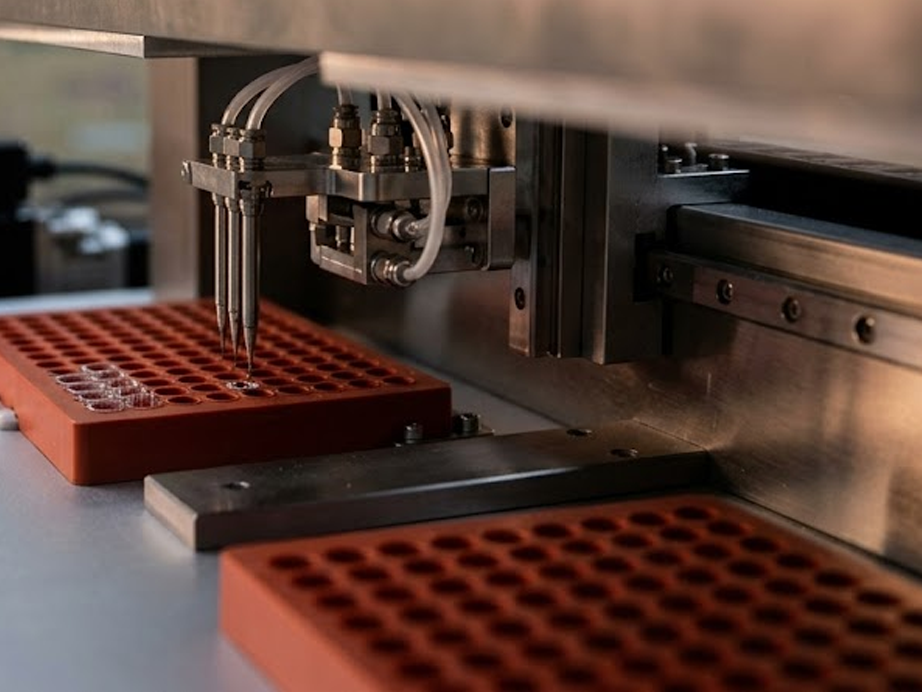
From pore scale to full jelly roll.
Electrolyte infiltration and wetting are simulated at the pore scale using the Lattice Boltzmann Method (LBM), which resolves capillary-driven multiphase flow through the 3D electrode microstructure. The output is a saturation map, a wetting front progression and a filling time as functions of electrolyte properties and electrode architecture.
Continuum-scale Finite Element models in COMSOL Multiphysics complement this by simulating Darcy-driven transport and phase distribution across full cell geometries such as jelly rolls. That bridges the gap between pore-scale physics and cell-level filling protocols. The two scales are calibrated against each other.
Every step from pore to full-cell filling.
Lattice Boltzmann (LBM)
Pore-scale, capillary-driven multiphase flow through the 3D microstructure. Predicts saturation maps, wetting front progression and filling time as a function of electrolyte and electrode architecture.
Continuum FEM (COMSOL)
Darcy-driven transport and phase distribution across full cell geometries (jelly rolls, prismatic stacks), bridging pore-scale physics to cell-level filling protocols.
MLP wettability surrogates
Multi-layer perceptron surrogates trained on LBM-generated databases. Accelerate infiltration predictions by orders of magnitude, so high-throughput screening of electrode designs for wettability becomes practical.
Microstructure history meets electrolyte wettability.
The manufactured electrode microstructures carry the full history of slurry formulation, drying conditions and calendering degree. They feed directly into the pore-scale wetting simulation, so porosity, tortuosity and CBD distribution shape the predicted saturation maps and filling time.
That closes the loop from manufacturing parameters to filling behavior. Whether the change is a new formulation, a different drying ramp or a calendering setpoint shift, it is evaluated against wetting uniformity, filling time and dry-zone risk in one consistent simulation chain.
What filling teams ask.
Design electrolyte filling protocols without sacrificing cells.
Send a cell geometry, a target filling time and a chemistry. We return a wetting study, a filling protocol candidate and the expected saturation KPIs.