
Mechanical compression simulation with downstream consequences.
DEM resolves particle rearrangement, contact deformation, porosity reduction and spring-back. Bonded-particle extensions predict fracture. Time-dependent AI surrogates compress the full calendering trajectory from hours of DEM to seconds of inference.
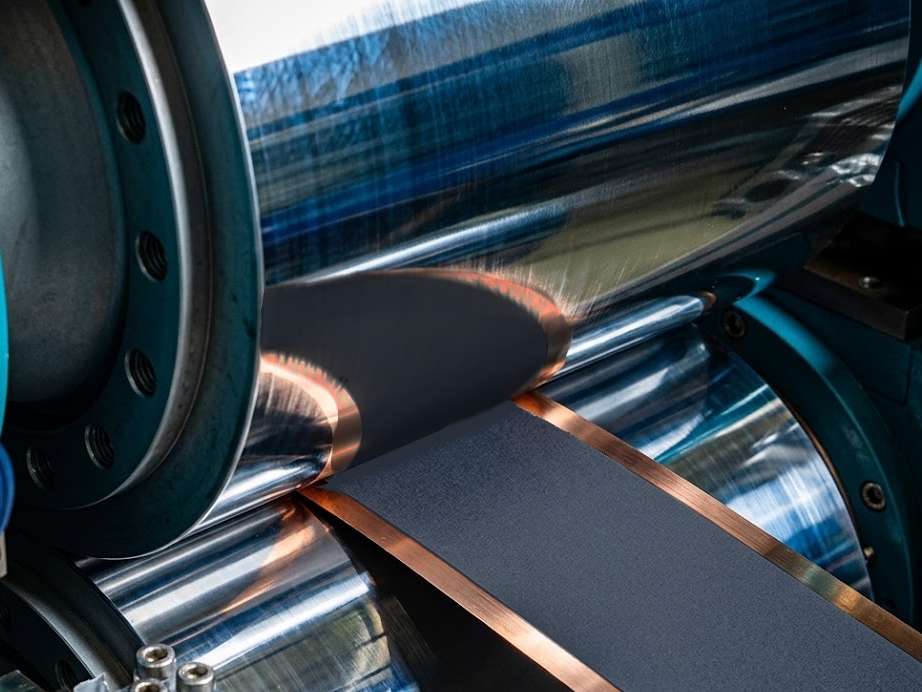
Contact forces, spring-back and particle fracture, resolved.
Mechanical compression is primarily simulated using the Discrete Element Method (DEM), which resolves particle rearrangement, contact deformation, porosity reduction and spring-back under uniaxial loading. The result is a 3D microstructure that carries the full history of the electrode (slurry, drying, compression) into downstream models.
Extended DEM formulations with bonded-particle models also predict particle fracture during aggressive calendering, a critical failure mode for brittle active materials such as high-nickel cathodes. The resulting microstructures give direct access to effective transport properties (tortuosity factor, electronic conductivity, active surface area) that feed the downstream electrochemical models.
From hours of DEM to seconds of inference.
DEM compression
Particle rearrangement, contact deformation, porosity reduction and spring-back under uniaxial loading. The reference physics for calendering simulation.
Bonded-particle fracture
Extended DEM formulations predict particle fracture during aggressive calendering. A critical failure mode for brittle high-nickel and silicon-bearing active materials.
Time-dependent DL surrogates
Trained on DEM-generated compression time-series. Deep-learning surrogates reproduce the full calendering trajectory, relaxation included, in seconds, with mean squared errors below 2%.
Bayesian optimization
ML regression combined with Bayesian optimization navigates the calendering parameter space (compression degree, line speed, formulation) against multi-objective targets such as energy density versus power capability.
Real-time monitoring meets predictive control.
Mixed-reality-assisted approaches, coupling computer-vision detection of calender roll parameters with real-time ML inference, have been demonstrated for in-line predictive monitoring. The same surrogate that accelerates design-space exploration in the office runs at line speed in the plant, fed directly by camera measurements.
This closes the loop between calendering settings and downstream electrochemical performance. A setpoint change at the calender becomes a predicted change in capacity, rate capability and cycle life within seconds, without weeks of physical commissioning.
What calendering teams ask.
Calibrate the nip to a downstream capacity target.
Share a target microstructure and a downstream performance objective. We'll return a calendering parameter window and a DEM-trained surrogate scope.